


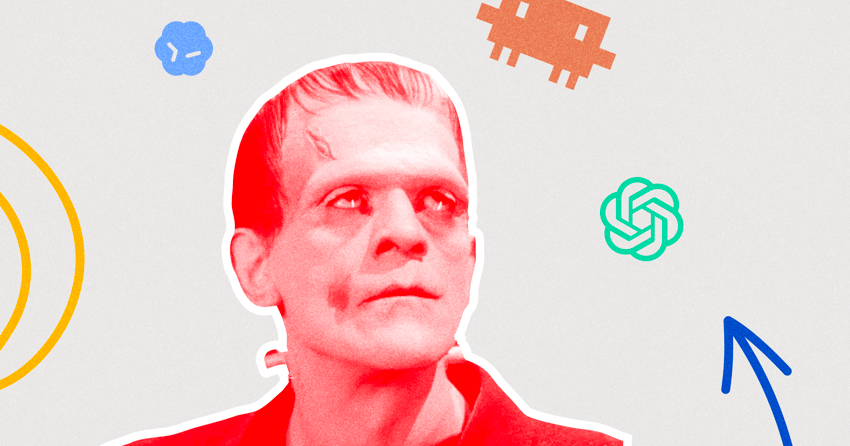
Much of what the AI in Design 2026 report describes (designers shipping code, broader role definitions, the search for new team structures) isn’t new everywhere. We’ve been refining a cross-disciplinary practice for over a decade. The report charts its emergence in the mainstream, but one metaphor that’s followed it into the coverage ("Frankenjobs") doesn’t quite fit what the practice actually looks like.
What the report unearths
The AI in Design 2026 report, from Designer Fund in partnership with Foundation Capital, surveyed over 900 designers across 60+ countries. It catalogues a profession mid-mutation. 91% of respondents now use AI weekly, up from 54% last year. Half of them have shipped AI-generated code to production. The average designer toolstack has more than doubled, from three to seven tools.
The shape of design work itself is also shifting. Towards systems thinking, code, and cross-functional ownership:
Half of the leaders we surveyed report that when they hire designers now, they’re placing greater emphasis on AI fluency, followed by systems thinking and strategic skills. 22% are placing more emphasis on technical or coding skills.
Fast Company picked up the report under the headline AI imagineer. Design crafter. Builder. Why design is suddenly full of Frankenjobs.
"Frankenjob" puts a name to the discomfort of role-blurring vividly: parts forced into one body, stitched together, the results more contradiction than coherence. Hideous new titles are emerging from the laboratory floor: designer engineer, AI imagineer, builder, design crafter. Designers really are doing PM and engineering work, and vice versa...
Who’s the monster here?
In Mary Shelley’s epic tome, Frankenstein is the creator, not the monster. Victor built his creature and walked away from it:
Oh! no mortal could support the horror of that countenance. A mummy again endued with animation could not be so hideous as that wretch. I had gazed on him while unfinished; he was ugly then; but when those muscles and joints were rendered capable of motion, it became a thing such as even Dante could not have conceived.
The story’s horror lives equal parts within Victor’s abandonment as it does the unorthodox form of his nameless progeny.
Designer Fund’s Ben Blumenrose, in the same Fast Company piece, described the prior orthodoxy:
For the past two decades, the way we built software was the same for the most part. Someone came up with a concept of what they wanted to build, they’d work with a PM [project manager] to figure that out, they’d bring on a designer to give the visuals to that thing, then pass it to the engineer to build.
Stepping out of the laboratory: AI is clearly making designers more capable and fast, and the report captures that clearly.
What’s harder to see is the work that doesn’t get easier: building shared context, shared artefacts, and shared understanding between the people who now bring broader skills to the table. The "Frankenjob" feeling lands at that seam, not in the new roles themselves. That practice doesn’t take a multi-year cycle to form, but it does take intention.
The Fast Company article makes it sound like these monsters never existed, and that AI (Victor) is the sole progenitor of these cross-disciplinary forms. In truth, some teams of designers, engineers, and product people have been working this way for quite a while now. AI didn’t create the practice; it just made it visible at scale. We’re one of those teams.
How to do better than Victor
In 2017 we brought a credentialed designer into what was an engineering-led company. By 2020, our then-design director Lauren Argenta had distilled our practice into a five-behaviour framework called Engineering-led design:
- Context together. Everyone attends early discovery, regardless of discipline. Designers learn the technical constraints in real time. Engineers see what designers see in user research.
- Create a dictionary. Define shared vocabulary as you go. Acronyms get unpacked. Practice-specific jargon gets reserved meanings. The dictionary becomes a bridge between disciplines.
- Teach as you work. Short, structured asides between disciplines. Thirty-minute sessions on graph theory, spatial localisation, or whatever the team needs to unlock. Framed as a first-class part of daily work, not a distraction.
- Play it back to validate. Reveal your thinking before you commit to it. Surface hidden assumptions. The team catches what an individual would miss.
- Break down language barriers. The majority discipline translates for the minority. In an engineering-led environment, that means engineers do the translating.
These five behaviours became the seed of a broader framework: the cross-disciplinary principles, mindsets, and approaches we use when helping clients. In a 2023 retrospective on a complex accounting app project, Ben Derham and Chris Dale described what happens when a team sets up using this framework: a core team of Product owner, UX lead, Tech lead, and Design-engineer, all co-piloting with equal responsibility. They worked directly in the browser wherever possible, and used a schema-first approach to surface dependencies and build a shared vocabulary. This way of working sounds eerily like the franken-practices that are emerging today!
Lab notes for the curious
If you’re running a design team and beginning to understand the value that this monstrous way of working offers teams like yours, here’s a few practical takeaways to help navigate the shift that we found meaningful:
- Check out Shamsi Brinn’s No Handoff framework. A manifesto for replacing waterfall handovers with synchronous, cross-disciplinary collaboration.
- Read the Thinkmill Method. It’s our synthesis and magnum opus of all things cross-disciplinarity.
- Talk to engineers, often. Cross-disciplinary practice depends on small, frequent, low-stakes conversations more than formal handovers.
- Work together in real time. The biggest gains we’ve seen come from designing and engineering in the same room (or the same call), in the same artefact, in the same conversation, not handing assets back and forth. As AI gets faster, and AI companies define better multi-player experiences (thanks Maggie!), this is becoming a lot easier to achieve.
Every team’s path to cross-disciplinary practice will look different. But the shape of the practice itself is familiar: people working together in shared language, building in parallel, learning from each other over time.
If you’re navigating this shift in your team and want a second pair of eyes (or hands), reach out for a chat.