Coming together in Sydney
In May the whole team came together in Sydney for our annual gathering. With several of our clients keeping Sydney offices, it was also a chance to spend time on-site with the people we build for.

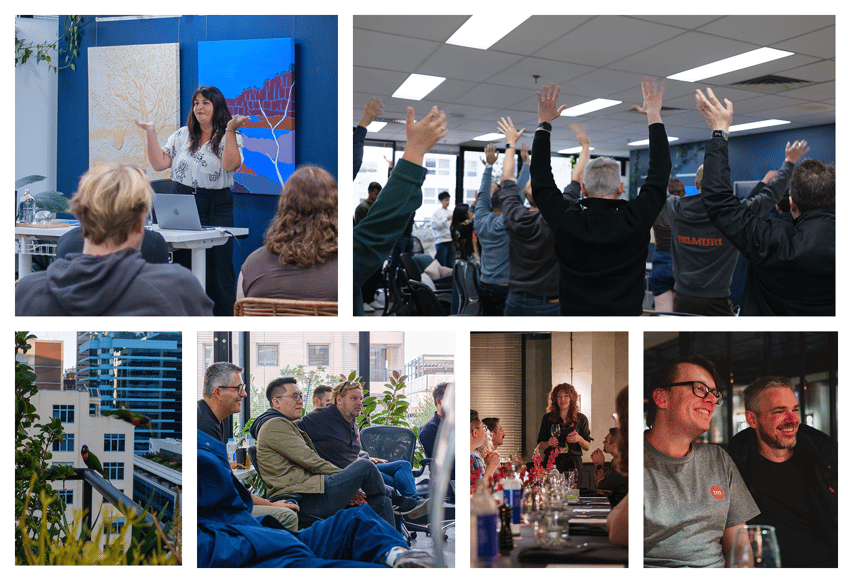
Our customary share day brought a fascinating set of presentations. A few themes carried across them: how and where we add value beyond pure delivery, the ways AI is changing what we can offer clients, and a set of tech talks on agentic design and engineering — context, scoping, sandboxing, and behaviour-driven development.
The design system proposition has never been more compelling
The case for a design system used to rest on consistency and speed at scale. That still holds, but AI has sharpened it. Coding agents can generate a working UI in seconds; but whether it stays coherent with the rest of your product is the open question. Without a system to lean on, every generation makes dozens of micro-decisions — a red that’s nearly your brand red, spacing that’s close but not quite — and you get what Joe Prisk calls drift at speed: the same old inconsistency, produced an order of magnitude faster.
A well-structured design system collapses that decision space, so the agent composes from your tokens and components instead of inventing. In effect, the system becomes the spec. That’s why some technology and design leaders are arriving at design systems from a different direction. Consistency was always the draw, but the real value now is keeping AI-generated work coherent with everything around it. It makes a well-maintained system more valuable than ever.
We’ve updated our design systems service page to better reflect where the practice is heading.
A multi-year partnership with AusCycling
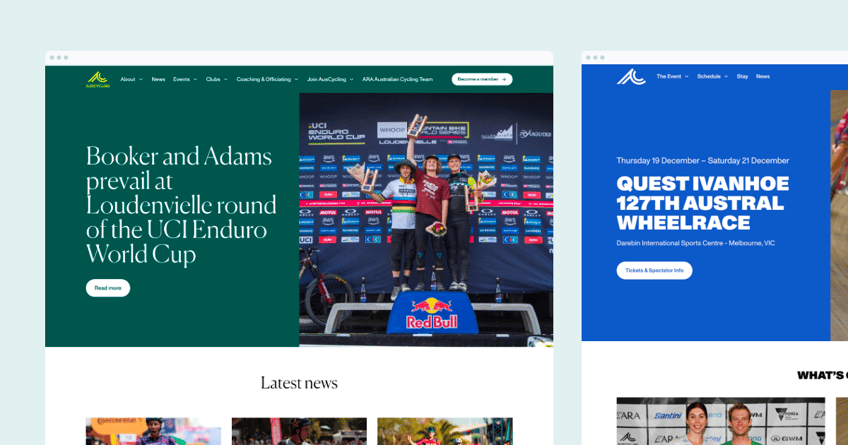
We published a new case study on our ongoing work with AusCycling, the national body for cycling in Australia. Over a multi-year partnership we’ve helped them move from a series of disconnected sites to a single platform that publishes to multiple branded experiences, with editors able to launch and update them without waiting on developers.

Helping government and NGOs
We’ve also put up a new page on how we work with Australian government organisations and NGOs — building secure, accessible services that fit existing teams and governance, and hold up over time. Take a look.
From the blog
Why your design system is the most important input to Claude Code: Joe Prisk on why coding agents need a design system to lean on. Given the same prompt, an agent with no guidance reaches for inline styles and one-off colours; with a system, it reaches for your components. The system is what keeps AI-generated interfaces from drifting.
What engineering teams owe for the AI speed boost: Also from Joe: the speed AI gave us wasn’t free. Code nobody fully understands, thinner reviews, heavier dependencies. He’s especially sharp on junior engineers who spent a year prompting rather than building, and the mental models that gap leaves behind.
A behavioural framework for the monsters in your team: Ronald Aveling argues that cross-disciplinary teams aren’t new monsters made by AI; they’ve been around for years. The piece sets out five behaviours that make them work, from shared discovery to translating language between disciplines.
A self-healing feedback loop: Michael Parker harnesses AI to wire product errors and user feedback straight through to fixes. A concrete look at what an agentic loop does to turnaround.
Faster CI pipelines: share build artifacts across independent jobs: Dinesh Pandiyan on a build-once, use-everywhere pattern for CI: build your artifacts once and share them across parallel jobs instead of rebuilding in each. Worth a look if your pipeline rebuilds the same thing several times over.
Curated links
Broider: A small tool for building decorative CSS border and margin patterns visually, then copying the code straight out. A remarkably sticky little applet you didn’t know you wanted until you’ve played with it for ten minutes.
A prompt injection in the wild: Artur Sapek got tired of AI recruiters and tucked a prompt injection into his LinkedIn bio. Now the bots message him in Old English and address him as Lord. A funny, slightly unsettling look at where automated outreach is heading.
The Context Development Lifecycle: As coding agents get more capable, the bottleneck moves from writing code to giving them good context. Patrick Debois proposes a CDLC: a way to generate, evaluate, and keep improving the knowledge agents rely on, much as DevOps reshaped delivery.
Rothko by the weather: For the abstract expressionism fans: a tiny app that picks a Mark Rothko painting to match the weather where you are.
Thanks for reading! Until next time 👋